Clear vision has a different meaning when protective eyewear must also accommodate a person's prescription. Ordinary goggles may provide coverage and impact resistance, but they do not necessarily correct refractive errors. Prescription tactical goggles combine these two considerations, creating a more specific set of requirements around lens compatibility, fit, protection, and optical clarity.
Regular protective goggles are generally designed around the assumption that the wearer can see clearly through the supplied lens. Someone who needs correction may instead have to place prescription glasses underneath, which can create additional pressure, movement, or fogging depending on the frame geometry.
Tactical prescription eyewear takes a different approach by considering vision correction as part of the overall configuration. The prescription itself may vary substantially from one wearer to another, so compatibility with the intended optical solution matters more than simply having a large lens.
Fit becomes particularly important in this situation. Extra space may be required around the face, while the corrective lens and protective lens need to maintain an appropriate relationship with the eyes. Poorly matched dimensions can affect comfort even if each individual component is suitable.
A corrective lens helps the wearer see more clearly, but prescription strength does not automatically indicate impact protection. Conversely, a protective lens may resist mechanical impact without providing the correction required by the user.
This distinction is important when evaluating prescription tactical goggles. The optical correction, protective construction, lens material, and applicable testing information should be considered separately so that one feature is not mistaken for another.
Fogging presents another challenge. Temperature differences, humidity, physical activity, and enclosed environments can cause condensation on lens surfaces. If fog develops across a corrective optical surface, visual clarity can deteriorate quickly, making anti-fog performance particularly relevant to prolonged use.
Regardless of the prescription configuration, the underlying protective frame should still meet recognized standards such as ANSI Z87.1 or EN ISO 16321-1:2022 for occupational eye and face protection.
Frame geometry affects much more than appearance. The shape determines how the goggles sit against the face, how much surrounding area is covered, and how comfortably the wearer can maintain a consistent viewing position.
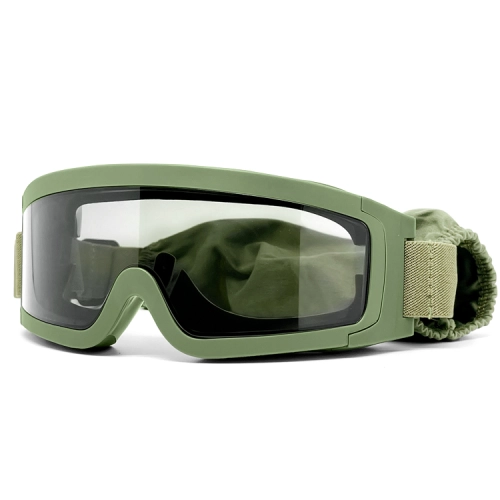
Our RK17 Tactical Airsoft Goggles use a TPU frame with a PC lens and feature anti-fog and impact-resistant lens characteristics, with MIL certificate and CE specifications provided for the model. The design supports OEM customization, including product and logo customization, and the MOQ is 300 pieces. These details demonstrate how protective construction and customization can be considered alongside the needs of different tactical applications.
For users requiring corrective vision, the available configuration deserves careful checking before purchase. Tactical prescription eyewear may require specific optical arrangements, and not every protective frame is automatically compatible with every prescription solution.
Facial dimensions differ from person to person, and prescription requirements introduce another variable into the fitting process. Nose position, temple spacing, lens distance from the eyes, and frame width can all influence the final wearing experience.
A well-fitted prescription tactical goggles configuration should remain stable without excessive pressure. If the frame shifts repeatedly, the corrective optics may no longer remain in the position intended for the wearer. Stability is particularly relevant during activities involving walking, running, training, or rapid changes in direction.
Compatibility with other equipment can matter as well. Tactical users may wear helmets, communication equipment, masks, or other protective gear. The frame needs to coexist with surrounding equipment without creating unnecessary interference, although the exact combination depends on the application and individual setup.
The first question is whether vision correction is actually required during the intended activity. Someone with unrestricted vision may have little reason to pursue a prescription configuration, while a wearer who depends on corrective lenses may value a more integrated solution.
Tactical prescription eyewear should then be assessed according to several separate specifications: corrective compatibility, lens material, impact characteristics, anti-fog performance, coverage, frame dimensions, and relevant certifications or testing information. Comparing these details provides more useful information than relying on product category names alone.
At YIJIA Optical, we consider the intended environment before discussing customization, because military, law enforcement, airsoft, paintball, and outdoor applications can involve different practical requirements. Prescription tactical goggles may offer a more integrated approach for users who need both correction and protection, but the appropriate configuration still depends on the individual's prescription and operating conditions.
Prescription and regular tactical goggles share the basic purpose of protecting the eyes, yet the addition of vision correction changes how the entire product needs to be considered. Optical correction, protective materials, anti-fog characteristics, frame geometry, compatibility with other equipment, and individual fit all have separate roles.
At YIJIA Optical, we approach tactical prescription eyewear through these combined requirements, recognizing that a protective frame and a corrective optical solution must work comfortably together. The most suitable configuration comes from matching those specifications to the wearer and the environment rather than assuming that one design fits every use case.

