A ski goggle sits at an unusual boundary: it needs to separate the face from cold moving air while still allowing heat and moisture to escape. That balance becomes especially relevant when evaluating UV 400 Ski goggles, because optical protection is only one part of outdoor performance. A well-designed facial seal must respond to wind, temperature, perspiration, and movement without turning the space inside the goggle into a completely closed environment. At YIJIA Optical, we consider this interaction when developing sports eyewear, since comfort often depends on several small structural decisions working together.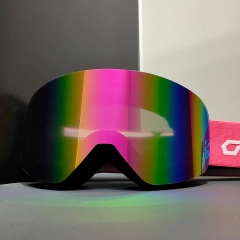
Wind chill is influenced by the movement of air across exposed skin. A goggle cannot change the outdoor temperature, but its facial interface can affect how directly cold air reaches the skin around the eyes and upper face. Foam therefore serves a functional role beyond cushioning: it helps create a controlled boundary between the wearer and the surrounding environment.
The thickness, density, compression, and placement of the foam can all influence that boundary. Excessively rigid material may create uncomfortable pressure points, while foam that compresses too easily can change the fit during movement. A carefully selected structure allows the goggle to maintain facial contact without requiring excessive strap tension.
The challenge lies in creating enough separation from external airflow while preserving the internal conditions needed for comfortable wear.
A completely sealed cavity is not necessarily desirable. Heat and moisture produced around the face can accumulate inside the goggle, particularly during climbing or high-intensity skiing. If humid air remains trapped against a colder lens, condensation becomes more likely.
A micro-ventilated foam design can incorporate small pathways that help influence air movement without turning the entire facial seal into an open channel. The effectiveness of such a design depends on pore structure, foam density, frame geometry, and the location of the ventilation openings. These variables should be considered together because changing one can affect the others.
For magnetic snowboard goggles, interchangeable lens systems introduce additional design considerations, making it important to evaluate the facial interface, lens architecture, and airflow requirements together. Airflow needs to remain compatible with the lens architecture rather than being treated as a separate frame feature.
Good ventilation is therefore less about maximizing air volume and more about controlling how air moves through the goggle.
Facial contours vary considerably from one user to another. A seal that works well for one face may place pressure in a different area for another person, which is why foam behavior matters during product development. Compression characteristics can influence how evenly pressure is distributed around the frame.
Helmet compatibility adds another variable. A helmet can alter the available space around the forehead and sides of the goggle, while straps may pull the frame differently depending on the helmet's shape. The facial seal should retain its intended contact without creating excessive pressure or unwanted gaps.
Our approach at YIJIA Optical takes these practical relationships into account during sports-eyewear development. We work with different frame and foam configurations so that comfort can be considered alongside optical and structural requirements.
A useful fit assessment should reproduce the complete equipment setup rather than evaluating the goggle by itself.
Different foam configurations can provide different combinations of softness, support, and facial-contact characteristics. Single-layer structures may offer a relatively straightforward interface, while multi-layer arrangements allow designers to vary the characteristics across different sections of the facial contact area.
The YH693, for example, uses a flexible TPU frame and supports single-, double-, or triple-layer high-density foam configurations. Its soft nose guard, elastic anti-slip strap, and OTG-compatible design further illustrate how the facial interface can be considered as part of the overall goggle architecture. These specifications demonstrate how the facial interface forms part of a larger product architecture rather than functioning as an isolated comfort component.
For UV 400 Ski goggles, foam selection should also be assessed alongside lens protection and ventilation. UV performance comes primarily from the optical system, while foam contributes more directly to fit, facial contact, and the management of the internal environment.
The practical goal is to make these individual functions complement rather than interfere with one another.
Laboratory conditions rarely reproduce every variable found on a mountain. Wind direction can change during a run, physical exertion can increase rapidly, and temperature may differ substantially between a sunny slope and a shaded section. Snow, moisture, helmets, masks, and prescription glasses introduce further variables.
Product testing should therefore examine the goggle under different combinations of activity and environmental conditions. Developers can look at pressure distribution, internal humidity, lens condensation, airflow, and stability after prolonged wear. Such observations can reveal interactions that are difficult to identify from material specifications alone.
For brands developing magnetic snowboard goggles, these tests can be particularly useful because lens interchangeability may introduce additional handling and structural considerations. A modular optical system still needs a stable frame and functional facial interface.
Understanding how components behave together gives product teams a more realistic basis for refining the design.
A foam seal has a deceptively complex job: it needs to reduce direct exposure to cold air, maintain comfortable facial contact, and coexist with a ventilation system that allows heat and moisture to move through the goggle. Its density, compression behavior, thickness, and relationship with the frame can all influence the result. None of these factors should be assessed in isolation because the final experience comes from their interaction.
At YIJIA Optical, we apply this system-oriented view to sports-eyewear development, including products such as the YH693 with its customizable TPU frame and multiple high-density foam configurations. For businesses evaluating UV 400 Ski goggles, the facial interface deserves attention alongside lens technology, while brands considering magnetic snowboard goggles can benefit from examining airflow, fit, and interchangeable-lens architecture as one connected design problem.

